Monday, May 31, 2010

Kirkin' O' The Tartans

Yesterday I attended a Kirkin' O' the Tartans (church service) in Montreat, NC (near Swannanoa, where we're staying). What an elegant and rousing tribute to family and Scots heritage!

Being the day before Memorial Day, there was a salute to our service men and women that began with the congregation leader asking all active military personnel to stand. He then asked all veterans to stand and join them ... then asked all spouses, parents, or children of deceased veterans to stand. At this point, standing, I sort of lost it. I often miss my father most keenly when I'm in his "home territory" of Western North Carolina and this, combined with the pomp and ceremony of the whole service, put me a little over the top, emotionally.

I'm really happy to be part of a heritage that honors family and commitment.


Monday, May 17, 2010

Camp Ground Baptist Church, Ozark, Alabama


On Sunday, May 9 (Mother's Day), we set out for Ozark, Alabama, to Camp Ground Baptist Church, which is pastored by my long-time friend Al Sonanstine.  Al was Minister Of Music at First Baptist Church, Arcadia, Florida, during the time I served there as organist.  It was so wonderful to see Al, his wife Peggy, and their children Jason and Adrienne -- and Jason and Adrienne's respective fiances.  (It's been a while since I saw them!)  

Matt Miller (fiddler) and I were to play a concert during the evening worship service.  The service was kicked off by Camp Ground's praise band, led by Jason, and I was mightily impressed with the power and musicality of this mostly self-taught group of musicians!  They were a tough "act" to follow!  

Our concert had been billed as "A lively evening of instrumental Celtic and Bluegrass, Storytelling, and favorite old-time Hymns."  The audience was part Camp Ground Baptist congregation and part guests from other community churches -- and all some of the most supportive and welcoming people you could ever hope to meet.  

I can't really say exactly what was my favorite part of the evening.  I loved playing the Celtic tunes with Matt, since the last time we played that material together was back in December, in our "Christmas With The Celts" concerts.  It's been even longer since I accompanied Matt (on guitar) on his "Teetotaler" medley or the "Orange Blossom Special," so this part was a lot of fun for me.  But we very, very rarely, play the old hymns together -- stuff like "Will There Be Any Stars In My Crown?" or "I'd Rather Have Jesus" -- and it's even more rare that we play to an audience who knows every single word and sings with such enthusiasm.  So perhaps I've just figured out my favorite part of the evening!

It was a treat and a blessing to be part of the Camp Ground Baptist family, if only for a few hours!  "Thanks" somehow seems inadequate to express my gratitude for the opportunity, but ...

Thanks!

Monday, April 19, 2010

Slow Down


There's no supermarket in White Springs.  Actually, these days, there's not a whole lot of anything.  There's a post office, of course ... a couple of fuel stations which offer some convenience items ... a Dollar General store, a bank, maybe a couple of antique stores and the Suwannee Yoga Center.  And a few churches.  The State Folk Culture Center is here, and when it hosts the Florida Folk Festival in May, the town's population will temporarily swell to about ten times its usual 800-900.  It's a sleepy, tranquil place; as Greg observed today, "Life's a lot slower here, and it forces you to slow down too ... and that's nice."

In its heyday, White Springs was a busy place.  It was Florida's first real tourist attraction, drawing visitors to the healing waters of the White Sulfur Springs as early as the 1830's.  The excellent surrounding land supported a thriving cotton industry, and the pine forests provided timber and other products such as turpentine.  White Springs became a refuge for Southerners displaced by the Civil War.  Centuries prior to all that, the healing mineral springs were considered by the Native Americans to be a special, peaceful place where warring tribes could come to put aside their differences as they drank and bathed in the waters.

But all that was long ago, and though many of the old structures remain, White Springs itself no longer bustles with commerce.  It probably began its decline before the advent of the supermarket.  And since White Springs does not boast any of the components that make up the modern supermarket -- bakery, butcher, green grocer, dairy market, etc. -- I headed over to Live Oak, one of the neighboring towns 14 miles away, to do our weekly shopping.  Such an arrangement requires considerably more planning than I've become accustomed to.  But this is the way I grew up, so I know it's entirely possible! 

Live Oak is much larger than White Springs, but it's still a fairly small town.  My shopping experience was at first a bit frustrating, as it seems that the Publix grocery store is the place to meet and visit friends.  When I shop, I'm used to being able to easily navigate nice, wide aisles; I didn't care much for dodging shopping carts while their drivers chit-chatted about yesterday's church social, or the upcoming school function.  But I remembered what Greg had said earlier, and I eased up and slowed down.  I also remembered how, growing up in a small town very similar to Live Oak, I hated for people to come in and try to impose their standards on our way of life.

Leaving the store with my purchases, I was assisted by one of the "baggers," an older gentleman who commented on the day's beautiful weather.  "Now if it was just like this every day of the year, it'd be all right," he said.  

I smiled and said, "If it was like this every day of the year, everyone would want to live in Live Oak, then pretty soon you probably wouldn't want to live here any more."

"I reckon you're right," said he.  "I lived in Miami for a while and it got to be too much of a mess for me.  That's why I moved here; it's quiet and it suits me just fine."

Yes, life's a lot slower here.  It forces you to slow down too ... and that's nice.

Sunday, November 1, 2009

The First


The picture shows the approach to our campsite here at Hanna Park.  Makes you want to join us, doesn't it?  Here's a little temptation: at night it's so quiet here, the only thing we can hear is waves crashing onto the shore.

Hanna Park is located on Florida's "First Coast."  We love to name our coastal regions in Florida!  Greg and I live on the Sun Coast, on Florida's west (Gulf Of Mexico) coast.  Another Gulf coastal region is the Emerald Coast, up in the "panhandle."  On the Atlantic side, there's the Space Coast (near the NASA launch site, naturally); a little further to the south, the Treasure Coast, and the area between Palm Beach and Miami is intuitively named the Gold Coast.

The First Coast is so named because it includes St. Augustine, the first permanent European settlement in the Americas.  Does that surprise you?  Our school history studies -- at least the parts that tend to stick with us -- are often laughably inaccurate when it comes to the settlement of North America.  When I was in the second or third grade, I learned that "Columbus discovered America."  At that young age, the obvious question never occurred to me: "If Columbus met Indians upon his arrival, shouldn't we call the Indians the true discoverers of America?"  In the fifth grade, one whole period of each day was devoted to American History, and what I remember best about the colonization of America is the story of the Pilgrims -- how they landed on Plymouth Rock and celebrated the first Thanksgiving with the native Indians.  In the seventh grade, my peers and I were required to take a course in Florida History, and it was through that course that I learned that St. Augustine, colonized by the Spanish in 1565, predates both the Plymouth Colony (1620) and the Jamestown Colony (1607).  Since Plymouth and Jamestown were both English colonies, and the Spanish were effectively kicked out of Florida in the early 1800's, I guess this is another example of how history is (re)written by the victorious.

Here's another tiny little surprise that involves the First Coast: Mayport, just to the north of Atlantic Beach, was founded by French Huguenots on May 1, 1562.  

More photos from Hanna Park


Monday, October 26, 2009

The Healing Power of Music

"The healing power of music."  It's a phrase that's often bandied about.  I wonder how many people really and truly believe that music has healing powers?

Even as a kid, I knew that music had power over me.  When I was frustrated, I could play the piano and in a matter of time my frustrations were diminished.  As a volleyball coach, I sometimes used music to fire my team up -- and learned during one unnecessary loss that it was possible to get them too fired up!  As a schoolteacher, I occasionally incorporated my dulcimer into lessons; I'm sure the unusual nature of the lesson helped it to be more memorable, but I'm equally sure that the music itself created a positive atmosphere that lasted for days.

I have performed music in different professional capacities since I was in my teens.  However, until I began doing gigs of a more intimate nature -- a nursing home, perhaps, or a bookstore or an art fair -- I did not have much of a chance to observe the effect of my music on others.  One of my most cherished memories is that of a a nursing home resident, a former dancer for Bob Hope's USO tours who was seemingly lost in the grip of Alzheimer's, responding to a lively jig set with a little wheelchair dance -- the nursing home added music to her therapy as a result.  

It was the recognition of the soothing power of music -- and the dulcimer in particular -- that was the impetus behind the recording of Celtic Heart.  For a couple of years I'd be playing my heart out on one of the slow airs like "Crested Hens" (from The Celtic Ray) or "Jock O' Hazeldean" (from A Celtic Heritage) and a massage therapist or yoga instructor would comment, "That music would be so perfect for my practice."  But then I would play another cut from the CD -- say a rousing reel like "Sound Of Sleat" or "Whiskey 'Fore Breakfast" -- and the response would be, "So pretty, but much too upbeat for my purposes.  Why don't you record a CD of all 'slow stuff' for people like me?"  So with a little research I prepared a body of music that mostly fit several important guidelines: the basic pulse of the music must be slower than the average adult's resting heart rate, the arrangements must not be too "busy," the tunes should not be associated with familiar songs.

The first person to derive benefit from Celtic Heart was, in fact, my own mother.  Recording took place in February (2006); in mid-April, my mother suffered a slight stroke that had been triggered by a massive infection that, due to many complications, would prove to be untreatable.  When I went to see her that April, I took my demo copy of Celtic Heart to share with her.  She loved "Danny Boy" (my only nod to commercial marketing) of course but said she liked the sweet music overall.  And I got a chance to see its calming effect on her, as I was with her two months later on the day she died.  The hospice workers had been using Celtic Heart, along with Be Thou My Vision, to soothe her beyond morphine's capacity to ease her constant pain.  Though she spent most of that last day in a coma, I know she was aware of my presence and I know she was responding positively to the music.  When she heard the melody of a favorite hymn (from Be Thou My Vision), her expression changed subtly.  And when she heard the slightly discordant passage that appears -- briefly -- on Celtic Heart, she became slightly agitated.  What a privilege to be with her on that day! ... and what a privilege to feel that I had made some positive contribution to her care.

I am commenting on this topic at this particular time because it was brought to mind in two separate episodes this past Saturday.  In one, a young mother wheeled her eight-month old baby into my booth and asked me to play.  My choice was "Crested Hens."  The baby's expression visibly softened and she sighed in relaxation several times.  When I stopped playing and started to converse with the mother, the baby began to wail -- and she immediately calmed when I began playing ("Inis Oirr") again!  

The second -- even more powerful -- incident actually began unfolding early in the day, as a couple came by to listen a while and look at CDs.  Some time later, they came by with an older woman who was confined to a special wheelchair -- likely she had been the victim of a stroke or other serious neurological trauma.  She was convulsing uncontrollably, so I focused my energies into playing as steadily and sweetly as I possibly could.  Amazingly, her tremors eased and finally ceased altogether as she listened.  It was a powerful and humbling experience.

And if I were not already a true believer in "the healing power of music" -- I certainly would be now.

Wednesday, August 5, 2009

Travelers

Tomorrow we complete the last leg of our journey to Ohio.  

Yesterday we had an amusing encounter which started out innocently enough, though somewhat counter to "campground culture."  For the most part, when we pull into a camping spot, we're given a pleasant nod by neighboring campers.  Usually, campers tend to mind their own business; after all, it's a tendency toward independence that attracts a lot of people to camping.  Sure, after a few days in a particular spot, someone might strike up a conversation with you, but when you're a "transient," an "overnighter," you're mostly left alone.

Occasionally, however, you do meet up with someone who, obviously craving company, seems to have been lying in wait, just for your arrival.  Such was the case yesterday.  We were setting up the trailer for an overnight stay, when the overly-friendly neighbor across the way came to offer a bit of advice and kibitz a little.  He started by asking how long we were staying; we stated that we'd be there only the one night since we were musicians on the road.  He didn't address that response; instead he started to offer more free advice, then changed his tack by taking note of our Airstream Trailer.  "Gosh, they don't make those things any more, do they?"  Without interrupting his work, Greg replied that Airstreams continue to be made and that ours was, in fact, only a couple of years old.  

"Yeah," the man said, "there was a bunch of gypsies that used to live not far from here and they all lived in old Airstreams."  I mused, half to myself, "Hmmm ... Travelers."  He brightened with recognition: "Yeah, that's what they were called, all right."  He went on to say, "They were a pretty strange crowd, always kinda kept to themselves, even married within their own group.  They didn't take none too kindly to outsiders."  I nodded to Greg, inadvertently talking over the man's further commentary when I said, "Sounds like he's describing Irish Travelers, doesn't it?"  I hadn't heard exactly what he was saying, but I could tell that his tone had become a little less than complimentary, in discussing those Irish  Airstream "gypsies."  Changing his course just one more time, our neighbor then returned to a previous topic to ask, "So what kinda music do you play?"

He blanched, but only briefly, when Greg, not betraying one ounce of emotion, said, "Irish music."

Funny how, after that exchange, we were left alone ...


Wednesday, June 24, 2009

Chesapeake Seafood

Greg and I went to Virginia's Northern Neck today.  Our goal: to see the Chesapeake Bay and eat some seafood ... and, basically, to see what there is to see in the area.

We began by turning east out of our campground.  The first 18 or so miles of our route took us through some spectacularly out-of-the-way places, past acres and miles of knee-high corn and some other grains that I could not identify.  Every so often we'd pass by an early 20th century version of a convenience store, but otherwise pretty much all we saw were the family farms of yesteryear: a farmhouse and a few outbuildings surrounded by acres of some crop or a freshly-tilled field waiting for planting.  Oh, and there was the occasional church -- most often Baptist -- with its adjacent cemetery, all the headstones like silent sentries, and all carefully and obviously arranged to face due east.

It seemed like such a long and lonely 18 miles!  Eventually we came to US Highway 17, the very same road which runs through my childhood hometown in Florida.  Turning south on US 17 we began paralleling the Rappahannock River, which we would eventually cross at Tappahannock.  Tappahannock seemed a quaint, bustling little place, but we did not explore it, as we had a ways to drive to our intended destination, Reedville.  

After crossing the Rappahannock onto the Northern Neck, we continued to see a number of farms but also started to see more and more evidence of a still-thriving seafood industry.  And, interestingly, more of the churches were Episcopal.  We passed through the charming village of Heathsville, which began as the Episcopal Parish of St. Stephen's back in the 1650's.  Wow.

We finally came to Reedville, selected as our destination because of its description as "a small waterfront town with a history in the seafood industry."  Beautiful and meticulously maintained Victorian-era homes line the Main Street leading down to the waterfront.  And though it's quite evident that the place had developed around commercial fishing and crabbing ... we saw no restaurants, seafood or otherwise, that were open for lunch.  Luckily, the proprietor of one waterfront eatery, already at work in preparation for the evening, sensed our situation, and was kind enough to direct us to Cockrells' Creek Seafood Deli, which was literally "across the creek" though we had to travel a somewhat circuitous route to get back in there.  It was definitely a locals' place; we'd never have found it without help.  And even if we had somehow managed to stumble upon the place, we probably wouldn't have gone in, because from the outside it looks a more likely warehouse or packing house than dining establishment.  Once inside, though, we discovered a spotlessly clean fish market with counter service and a tiny, neat-as-a-pin "dine-in" area.  We arrived shortly before noon, and good thing we did, because within a half-hour, it was jammed and the line at the counter was almost out the door.  Our lunch was everything we'd hoped for, and more: a seafood "sampler," everything delicately fried, with flounder, shrimp, scallops, oysters, and of course a crab cake.  I will tell you right now, I do not particularly enjoy oysters fried, preferring them instead raw and fresh-shucked, but these were absolutely the best fried oysters I have ever eaten.  Enough servings of Cockrell's oysters might make me consider the fried variety to be a favorite!  The crab cake was so fresh and perfectly seasoned, the scallops so sweet and juicy, the shrimp, the flounder -- ah!  Well worth the trip.
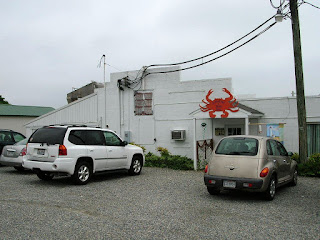


So worthwhile was that lunch that I'm not even disappointed that we never actually got to see the Chesapeake Bay.  Our road atlas indicated that Reedville was right on the bay, but it isn't.  And without a proper map of the area, we feared spending countless frustrating hours trying to navigate those winding centuries-old paths.  (How have we come to be the only "road-warriors" who do not own a GPS?)